
Earlier this year, I shared a photo on X of myself drinking tea at an outdoor cafe in Mogadishu. My main argument, written in response to a discussion about Somalia’s masculine cafe culture, was that although there are no laws explicitly restricting women’s use of public space, they still face deep, informal, cultural, and social barriers that shape how they can exist in the city. Women are largely absent from the public realm unless they are tied to an economic role or gendered responsibilities. According to UN-Habitat, women in many post-conflict cities spend less time in public spaces than men due to safety concerns, social norms, and mobility restrictions. Nevertheless, my post predictably triggered responses from men who used religion and culture to argue that women should not even idly ‘sit’ in public space, implying I had no reason to raise concern.
Who has the right to the space?
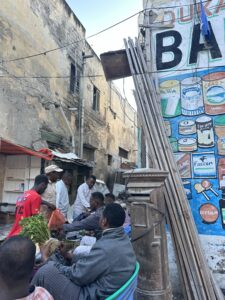
My experience living in Somalia and Yemen, both countries navigating conflict, recovery, and social fragmentation, pushed me to confront how public space, religious, cultural, and gender norms intersect in deeply political and personal ways to shape how we experience a city. These dynamics shape who is allowed to belong, who can feel safe, and who is permitted visibility and who is pushed into invisibility.
Both in Mogadishu and Aden, I would take local transport, buses, or Bajajs and observe everyday movement and interaction. It became clear to me how masculine and exclusive the public spaces felt. Men filled the streets, drinking tea, discussing social issues, and gathering with their male peers, enjoying the ordinary human interactions that should be accessible to everyone, including women, elders, and young people.
This pattern is reflected across research and reports on gender mobility and access to public space in fragile conflict-affected cities. UN-Habitat work on safer cities and post-conflict urban recovery consistency shows that mobility is unevenly distributed across urban populations, inevitably shaping who occupies and uses public and social spaces, resulting in men being far more visible in the everyday urban space while women’s presence is highly constrained.
“Women move through cities as though trespassing.’ — Shirley Geok-Lin Lim, Malaysian-born American poet, novelist, feminist scholar, and literary critic.
The right to exist in public, to take up space, to engage in everyday human interaction without fear or limitation, is a fundamental part of our dignity. Yet, women not only in Somalia, but across contexts where unequal power dynamics and gendered norms go unchallenged, this basic freedom is routinely denied. Their presence in public space is primarily confined to gendered responsibilities or economic necessity, such as grocery shopping, child care, healthcare visits, or informal work like street vending. Rarely do women in these cities occupy public space with the same ease or casual presence as men.
Several moments deepened my reflection on how gender shapes access to public space. At an outdoor cafe in Mogadishu, the staff greeted my friend and me and directed us towards the indoor women’s section. Utilising my diaspora confidence and privilege, I purposely requested to sit outside, a small decision that makes us visible, out of place, and unfamiliar with the city’s unwritten rules.
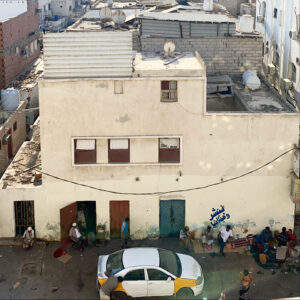
In Aden, I once walked home alone around 9 pm with no street lighting, and when I saw a group of men chewing khat on the pavement, I hoped to pass this awkward encounter as quickly as possible. At that moment, I understood why so many of my friends, colleagues and family members I knew in Yemen and Somalia felt more comfortable wearing the niqab in spaces where they felt exposed or unsafe, and would rather meet in private homes.
My experiences are minimal compared to those of displaced women and girls living on the margins of society and the city outskirts. Many face social exclusion, protection risks, and daily barriers that limit their mobility, access to services, and ability to benefit from urban development.
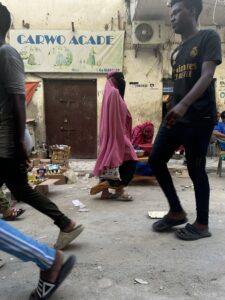
Invisible social rules and how we can overcome them
When we think about gendered experiences of navigating cities in fragile conflict situations, we have to reckon with the harsh reality that conflict also crystallises existing marginalisations and puts further pressure on protection, making progress difficult. For a woman escaping war, displaced and dependent on humanitarian services for shelter and food, this robs many of any time left to experience ease and therefore pushes the social unspoken rules of public space.
The legacy of war and protection threats hardens masculinities and deepens social norms that restrict women’s participation and visibility in public spaces. In Yemen, for example, women and girls frequently point out the common practice of husbands, fathers and brothers using violence as a warning to limit their time spent in public space to prevent perceived protection risks, including kidnapping and harassment.
In 2020, a young woman, Hamdi Mohamed Farah, in Mogadishu, was lured to an abandoned building, gangraped and pushed from a six-floor building. While the case created outrage among both local communities and the diaspora, behind closed doors it further reinforced tighter control over women’s movement, based on the belief that safety is achieved through limiting women’s access to public spaces, rather than accountability and justice.
Even in post-conflict reconstruction, the imagination of the systems is to reinforce the invisibility of women in public spaces. Public recreation is designed for male leisure spaces. Insufficient street lighting and safety measures often leave women and girls feeling unsafe in public spaces. Urban development projects do not address the gendered needs and experiences of women and girls, as well as their safety concerns.
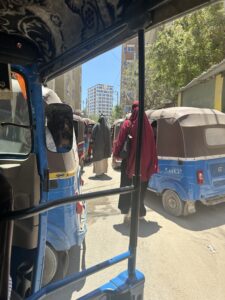
Market and commercial areas typically favour men’s economic participation, while women are often relegated to the informal sector. Consequently, our cities do not fully support women’s social and economic participation or adequately protect them from harm, thus reinforcing the gendered stereotypes that confine women and girls to the private sphere of home.
As with any social dynamics, gendered norms, assumptions, and beliefs are open and available to be called into question, especially when they restrict who is allowed to belong, participate or simply exist in public space. Social choices can be unlearned, reshaped, and/or reimagined, but what is also very much needed in cities like Mogadishu and Aden is recognition of the unequal access to public space, and a full recognition of women’s experiences and ideas of what a city that caters to their needs and is safe may look like.
Then go ahead and design cities to address these barriers and create an environment where women and girls can move freely, safely and participate fully in the everyday life of their city. This means building spaces that are inclusive by intention, where visibility is not a risk, where presence is not questioned and where the right to the city is genuinely shared. Build a city where everyone can belong.
Therefore, the question of who belongs in the city depends on who we design it for. This begins with us questioning the social norms, and perceptions that police women’s presence and existence in public spaces. It requires us to re-imagine our cities and built environment in ways that centre those pushed to the margins.
Sagal Abas Bafo is a feminist consultant, writer, and activist specialising in the humanitarian-development-peace nexus. Her work focuses on inclusive social recovery and crisis response in conflict-affected and fragile contexts, with particular attention to gender rights, local civic participation, transformation, and urbanization, centering the women, peace and security agenda. Sagal is a fellow at Somalia’s Center for Urban System and Innovation.