
On February 14, Italian Prime Minister Giorgia Meloni addressed the Assembly of Heads of State and Government of the African Union during the 39th General Assembly. In her speech, Meloni acknowledged that Africa is central, not peripheral, to global political and economic futures and that this is both timely and necessary. Furthermore, she stated that Italy’s foreign policy is built on mutual respect and cooperation, framing the Mattei Plan for Africa as Italy’s contribution to the AU Agenda 2063 and positioning Italy as a “bridge” between Europe and Africa.
Earlier, she had just attended the second Italy-Africa Summit, the first to be held on the continent. Her speech highlighted key areas of Italy’s focus in Africa: cooperation and strategic partnership; infrastructure and economic integration, debt cancellation for African countries; multilateral cooperation; migration; youth training; and climate change.
Extraction dressed as cooperation
The symbolism of this speech carries equal weight — delivered at a moment when Africa faces not only mounting humanitarian crises but a renewed scramble for its resources. What is said and what is not said are equally important. The Prime Minister specifically pointed to current extraction efforts, such as the Lobito Corridor, which stretches from the Atlantic coast of Angola through the Democratic Republic of the Congo (DRC) and Zambia’s Copperbelt, and has increasingly become a target of the United States and the European Union. Different actors are rushing to ‘invest’ in the railway and infrastructure links that would quicken the extraction of resources in the name of “connecting African markets to global ones, bringing people, ideas, and economies closer together.” Italy is at the forefront, the Prime Minister said.
The timing is telling. Italy’s speech at the African Union arrived alongside US Secretary of State Marco Rubio’s remarks at the Munich Security Conference, where he spoke openly of a “Western supply chain for critical minerals not vulnerable to extortion from other powers,” dismissed “anti-colonial uprisings,” and glossed over what amounts to a return of empire.
Within the broader push for a new Western century, Italy is positioning itself as a critical intermediary between Washington and Africa — leveraging its Mediterranean geography, energy dependencies, and migration politics.
The Mattei Plan casts Italy as both an energy broker and a migration gatekeeper for Europe, reinforcing extractive partnerships and outsourcing border control. For all its rhetoric of co-designed partnership, the Mattei Plan’s true architecture — funnelling billions through Italian state institutions to secure energy access and outsource migration control — reads less like a new chapter and more like colonial extraction dressed in the language of development cooperation.
The very name, Mattei Plan, evokes the legacy of Italian economic statecraft and ambition. It signals continuity with historical economic imbalance rather than a genuine emancipatory agenda for Africa. The Mattei Plan’s structures anchor the heavy involvement of Italian economic actors (development banks, export credit agencies, private-sector mobilising mechanisms). This prioritisation of investment-led partnerships risks aligning with extractive or neo-extractive logics, in which African labour, land, and resources serve as inputs to European capital accumulation, leaving no actual development in its wake. No doubt, African countries are in dire need of infrastructure that can catalyse development, but the constraints African states face are deeply rooted in a global political economy shaped by colonial extraction, exploitation, unequal trade regimes, debt dependency, capital flight, and externally dictated policy frameworks.
The Plan is tied to Italian political priorities around migration, which is often framed as a problem to be solved through aggressive policies designed in Europe, obscuring the structural drivers of global inequality, climate crises, labour precarity, and historical extraction that often compel mobility.
Projects that prioritize extraction of raw materials, history teaches, cannot deliver the much-needed change in the material conditions of the people. Moreover, such large foreign-driven ventures heighten vulnerabilities and displacement of rural and borderland communities, undermine women’s land tenure security, increase militarization and gender-based violence in transit zones and marginalize informal cross-border women traders.
The colonial extraction blueprint is here all over again. Railways and corridors were not built to connect African communities, but to extract resources outward, and this model is being revamped. African countries mustn’t be handwringed into such economic extraction in the name of integration, which reduces Africa to a theatre of great-power rivalry rather than an agent of its own development.
Reparations not tired Cooperation
Italy’s Prime Minister’s speech didn’t confront the weight of her country’s history in Africa, including Ethiopia, where she delivered it. Italy was not a passive bystander in the colonialisation of Africa. It occupied Ethiopia, Eritrea, Libya, and Somalia, where its wars killed thousands and decimated livelihoods and communities, leaving behind racial violence, land dispossession, and gendered atrocities. Italy must contend with its role in the plunder of Africa and the fragmentation of the continent, which is still impacting the relations and lives of many Africans today.
Erasure of colonial history at a time when the African Union is recognizing colonialism as genocide, and in a decade of reparations, is not the cooperation that serves Africans. Lack of acknowledgement of harm, no mention of reparative justice, no structural reckoning, but rushing to use the image of fighters like Nelson Mandela is what colonial erasure does. Meloni rushes to speak about equality as a present condition, not something arrived at through historical repair. Any genuine cooperation must confront the injustice done and support efforts to restore the dignity of the people of Africa.
Capitalist structures, debt and the question of sovereignty
Meloni framed Italy as a champion of African debt relief, pledging to transform the debt of “the most fragile and vulnerable countries into investments” — a promise that rings hollow, given that the underlying model still ties relief to European energy and security interests. A program to convert African debt “into investments,” but debt relief conditioned on alignment with Italian strategic priorities is less an act of solidarity than a rebranding of financial leverage that the West maintains through the World Bank and other financial institutions, wreaking havoc for decades.
Africa’s debt burden is linked to colonial extraction and unequal trade regimes and the climate crisis, driven largely by the actions of industrialized economies. Debt conversion and investment decisions remain largely controlled by creditor states and International Financial Institutions (IFIs). Debt relief must therefore move beyond management toward reparative justice that would ensure structural debt cancellation for the most vulnerable countries in Africa.
It demands the reform of global trade and financial systems that disadvantage African economies, fair taxation and regulation of multinational corporations operating in Africa and transparent and participatory mechanisms in debt restructuring and investment frameworks. Without structural shifts, cooperation risks reproducing asymmetries under a new terminology.
Debt tied to financial architecture that keeps African countries from responding adequately to public infrastructure needs also limits climate responses. Climate reparations should align with the principle of common but differentiated responsibilities and increased concessional financing that directly reaches marginalised communities and women-led enterprises. In this regard, economic justice must be transformative, not transactional.
Migration and Mobility of Africans
On Migration and Mobility, the Prime Minister aspires to create conditions in which young Africans are not forced to leave their countries due to poverty or instability. However, mobility is also a right. Migration is not merely a problem to be prevented; it is a survival strategy for Africans and a source of remittances sustaining national economies. Restrictive migration policies as administered by Europe and Italy often expose young Africans and women to trafficking, violence, and exploitation. Thousands of Africans have died on migration routes at the hands of agents, border authorities, and many have been made vulnerable, including increased modern-day slavery.
Recent EU laws, like safe country of origin definitions, give states greater powers to stifle the rights of migrants and asylum seekers. Italy and Europe’s border externalisation agenda has, over the decades, funded dictatorial regimes and non-state actors in the Sahel and North Africa, expanded offshore processing concepts, and advocated accelerated border procedures. These policies are framed as pragmatic governance, but they normalise containment, fast-track rejections, and restrict access to full asylum procedures, particularly for nationals of countries labelled “safe”.
In other contexts, such as the ECOWAS, freedom of movement continues to be shaped and constrained by external interests, including those of the European Union. EU funding for border management and migration control, such as infrastructure upgrades and capacity-building projects in Senegal, has direct implications for regional mobility, often undermining migrants’ rights and local economies.
A just partnership must include safe and legal migration pathways and the recognition of mobility as a dignity, not a threat. Securitisation of African borders defeats decolonial efforts to abolish colonial borders.
Ending Militarism?
Meloni’s address highlights instability in Sudan and the Eastern DRC. Naming instability without interrogating the political economy of war risks reducing conflict to an internal African pathology rather than a system sustained by transnational arms flows- including from Europe, mineral extraction networks, and geopolitical alignments.
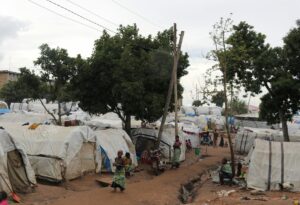
The war in Sudan that has displaced 14 million people and pushed millions into neighboring countries as refugees is embedded in regional and international arms transfers, financial backers, and external political calculations. Yet we have not seen commensurate political pressure or accountability measures that match the scale of the catastrophe. Accountability regimes remain fragmented. Arms diversion pathways remain insufficiently scrutinized. Civilian protection remains under-resourced.
Similarly, in eastern DRC, decades of conflict are sustained by the global demand for strategic minerals, cross-border armed group financing, and porous arms embargo enforcement. Without confronting the corporate supply chains and illicit financial flows that benefit actors beyond Africa, calls for stability ring hollow. Peace cannot coexist with profitable instability.
For women, girls and marginalised people affected by conflict, sustainable peace requires more than state stability. It requires implementing the Women, Peace and Security agenda, including UNSCR 1325 commitments, the rights of women human rights defenders and journalists, and providing direct financing for women peacebuilders and local mediators. More efforts should be made to ensure the ongoing political processes in Sudan are inclusive and transparent.
European states frequently frame themselves as champions of stability in Africa while simultaneously participating in global arms markets that fuel conflict elsewhere. Continued arms exports that contribute to violence in the Middle East, particularly in Gaza, with Italy arming Israel, have destabilizing ripple effects across regions, including Africa. Militarization does not remain geographically contained, but it reshapes alliances, fuels proxy dynamics, and normalizes impunity.
Artificial Intelligence, Innovation and youth exploitation
Dominant Digital infrastructures, such as data, cloud systems, and platform economies, shape the global power order. The calls for training African youth to participate in digital economies without corresponding ownership stakes, governance power, or data sovereignty leave them integrated as labour inputs.
We have already seen this pattern emerge. African workers are increasingly absorbed into the invisible back-end of the digital economy, content moderation, data labeling, algorithm training, and other forms of precarious digital piecework. These jobs are often low-paid, psychologically harmful, and structurally outsourced to jurisdictions with weaker labor protections. The language of digital opportunity can obscure the reality of digital subcontracting that continues to extract African labour while devaluing the lives of the workers.
AI, innovation, and training questions must be rooted in more than quick capitalist fixes. In a world where wealthy Western nations largely dictate the value of African labour, goods, and lives, these skilling programmes feed into capitalist extraction. AI systems depend on the massive harvesting of data, including language, biometric, and behavioural data, thereby advancing digital coloniality. When African populations become sources of raw data without regulatory sovereignty or revenue-sharing mechanisms, the continent once again supplies raw material, this time digital.
What does Africa need to do?
The speech from Italy presents itself as a vision of partnership. Yet, it reflects the priorities of a European state, interests defined largely outside the African continent, rather than a reimagined framework of justice for Africa. It assumes that Africa’s future can be shaped through Italian and European benevolence.
What the continent demands is justice, dignity, and a redistribution of power that addresses historical and ongoing imbalances. Cooperation is a potent word, only possible when structural inequality has been dismantled rather than softened or obscured. African policymakers must ask who owns the value produced or who controls decision-making to disrupt and end the reproduction of patterns of extraction.
The African Union and its Member States need to position themselves more strongly, with a clear agenda that focuses on reparative justice, fair trade systems that take human rights into account, to pave the way for migration policies that respect people’s rights.
In short, Meloni’s speech should be seen in light of its lack of a transformative agenda toward Africa. As Africa is positioned at the centre of global competition for infrastructure routes, strategic minerals, and energy transition resources, the continent cannot afford a repetition of historical patterns. Any efforts should strengthen intra-African trade and regional value chains under the African Continental Free Trade Area (AfCFTA), rather than function solely as export pipelines to Europe or other global markets.
Given Europe’s historical contributions to climate change and the destruction of African ecosystems, the African Union must be assertive and strategic in its approach to such proposals. It should, for example, demand concessional and climate-just financing models rather than debt-creating loans. The AU has an opportunity to articulate clear red lines and development benchmarks that ensure Africa’s resources, infrastructure, and labour contribute first and foremost to Africa’s development. Plans that paint Africa as homogenous, a place and its people to be exploited and controlled, cannot produce lasting changes. Yes, African culture has survived enslavement and colonization, it cannot disappear because some of its people migrate. Equality requires more than language and definitions; it cannot happen within an environment of renewed control and impositions.
The authors are part of the African Feminist Collective on Feminist Informed Policies – AfiP Collective.
Helen Kezie-Nwoha is a feminist scholar, peace-builder, and human rights advocate. She is the Founder and Lead Researcher at Researchers Without Borders and provides strategic policy advisory to regional institutions, particularly on the implementation of the Women, Peace and Security agenda. Helen currently serves as the Chair of the Gender is My Agenda Campaign (GIMAC) at the African Union and is a member of FEMWISE, the African Network of Women Mediators. She holds a PhD in Women and Gender Studies from Makerere University.
Rosebell Kagumire (she/her) is a Pan-African feminist writer and editor at African Feminism and serves on the Editorial Board of Minority Africa. She has contributed to the upcoming book, Rising for Palestine: Africans in Solidarity for Decolonisation and Liberation (March 2026), an anthology that brings together critical contributions from Palestinian and African scholars, intellectuals, and activists.
Pauline Kahuubire is an African Feminist who believes that feminist documentation and consciousness-raising as tools for dismantling oppressive power structures and building inclusive, intersectional, and peaceful societies. Her advocacy and knowledge-creation work advances Women, Peace and Security and Women’s Leadership. She has worked in Uganda, Kenya, Rwanda, Burundi, DRC, South Sudan, and the Central African Republic.
Toni Haastrup is the Chair in Global Politics at the University of Manchester. She holds a PhD in Politics from the University of Edinburgh. An award-winning teacher and researcher, she is a 2022 recipient of the Emma Goldman Award from the FLAX Foundation for contributions to feminist research and knowledge in Europe. In addition to her academic work, Toni frequently works with government organs and international organisations, offering expertise on themes linked to the Women, Peace and Security (WPS) agenda and Feminist Foreign Policy (FFP).