The African Charter on Human and Peoples’ Rights – a binding treaty between the member states of the African Union which guarantees individual and collective rights – was born from a radical dream in 1981 as a continent emerging from the scars of colonialism built its own architecture of hope. It was a promise of radical interdependence, a commitment to a world where the rights of one were the security of all.
But today, a look at our landscape one can’t help but see how this key pillar of our social-political existence is being systematically dismantled, brick by digital brick, by a coordinated transnational machinery of hate.
We are navigating the internal and external storms in our feminist advocacy every single day as we hold onto the remains of the African Charter. In high-level meetings, we talk about mechanisms and sterile frameworks. We use the language of the boardroom. But behind that legalese are real human lives caught in a pincer movement between rising state-sanctioned authoritarianism and what we have come to call the Algorithm of Violence. This isn’t some abstract theory. It is a reality that exists in the terrifying distance between the ink on a human rights treaty and the lived experience of a person simply trying to walk down a street in Lagos or Banjul.
In the Algorithm of Violence there are too many activists experiencing severe violence online, whether that is being doxxed, harassed, or chased off platforms that they have spent years cultivating as part of their activism. And as recent research by Noor and the Institute for Journalism and Social Justice points out, cash from the tech sector in Silicon Valley also flows to far-right civil society organisations and members of the political elite in Africa who have been advocating for the increased passage of homophobic laws on the continent.
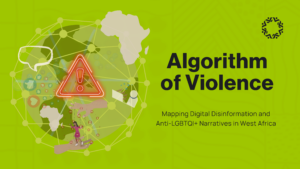
In West Africa, the evolution of this hate is terrifying. It isn’t just about bad laws anymore; it is about the digital disinformation that makes those laws possible. Our mapping shows that anti-LGBTQI+ sentiment is not a spontaneous eruption of tradition, but rather a coordinated information disorder. On platforms like X and TikTok, disinformation campaigns have co-opted the very language of our liberation. They have taken the raised brown fist of resistance and turned it into a tool of exclusion. In Burkina Faso, posters using our own imagery of grassroots power now read “Burkinabè united against homosexuality.” These are the precursors to the draconian bills in Burkina Faso, Ghana, and Senegal, where being seen is no longer a shield. It is a target.
This legislative assault is a continental contagion. From the Human Sexual Rights and Ghanaian Family Values Bill in Ghana to the recent criminalization of identity in Mali and Burkina Faso, the state is retreating from its duty to protect.
But African feminists and Queer activists continue resisting in spite of the different levels of violence they face – whether that be state-led, or as a result of tech giants refusing to prioritise the safety of vulnerable populations.
In Kenya, our comrades at the Initiative for Equality and Non Discrimination (INEND are fighting to queer the ballot, and their messages are out to challenge legislators that they are more obsessed with what happens in people’s bedrooms than the actual hunger in their streets. A Senator in Nairobi told us in a private briefing that these bills ruin lives just to gain political mileage. The violence of this visibility is a cruel paradox. Philanthropy often equates being seen with progress, but for a queer organizer, representation without protection is a liability.
The lack of protection is also something millions of African women and girls know intimately. The pressure is even being felt in our hard-won victories for women’s and girls’ rights. In The Gambia, we recently celebrated the upholding of the Anti-FGM law. It was a moment of profound collective power, seeing ex-circumcisers and religious leaders unite to say never again. But even this victory feels fragile. The push to repeal such protections is constant, fueled by a backlash that frames bodily autonomy as a threat to national values.
Where are the guardians of the African Charter?
Our regional institutions, from ECOWAS to the African Union and the African Commission, are supposed to be the Guardians of this architecture, yet here too the far right holds sway, with some member states leading the charge to strip observer status from any organization that doesn’t fit a narrow, state-sanctioned moral code. The genesis of this was obvious as far back as 2018, when the AU Executive Council successfully petitioned the African Commission on Human and People’s Rights (ACHPR) to withdraw observer status from the Coalition of African Lesbians. As Article 19, a global freedom of expression organisation, stated at the time:
“The AU’s decision demonstrates State parties’ continued onslaught on human rights institutions that question them on their human rights practices at home. By forcing the Commission to withdraw CAL’s observer status, the Executive Council has once again demonstrated African leaders’ regressive approach to human rights that views women’s and LGBT people’s equal enjoyment of human rights as ‘un-African’. This effort to undermine CAL and other groups’ legitimacy not only entrenches discrimination, but means women and LGBT people lose their voice in a vital human rights forum for Africa,”
As a youth-led, Queer, feminist organisation, our work has had to evolve to meet the moment. We are proactive in our advocacy, and movement building, and go beyond responding to the myriad crises that affect the communities we work with. We are leveraging data to track abuses in real-time, while fighting for the digital safety and data sovereignty of those who are most marginalized.
If we do not ensure that human rights protections extend to every African, no matter their identity, expression or sexuality, then we allow the African architecture of human rights to crumble. We will not only lose the girl in a rural village whose future was preserved because a law protected her from violence, but we will also lose the queer student who found safety in a Rapid Relief initiative when the State turned its back. And all of our people deserve safety and protection.
The movable middle of our continent must realize that the Algorithm of Violence never stops at one group. A system weaponized against a queer person today will be weaponized against a journalist, a protester, or any woman seeking justice tomorrow. To love our people is to protect the most vulnerable among us. The architecture of African human rights was built for liberation. It is time we stop watching the storm and start reinforcing the foundation. We don’t need a new architecture. We need the political courage to inhabit the one we already have.
We are standing at a crossroads where silence is a luxury that we can no longer afford. The shadows are long, but they are not permanent. In the end, a house built on hate cannot stand against a movement built on love, and as we shore up the foundations of our shared humanity, we must remember: we are the architects now. Let us build something that no algorithm can ever tear down.
Justin Chidozie is Co-Executive Director at CHEVS, where he works at the intersection of programme and strategy to advance progressive change. With a background in public policy and communication, Justin brings both strategic rigour and deep humanity to his work, building coalitions, shaping narratives, and showing up for communities that refuse to be shrunk. He is a disruptor by conviction and a collaborator by nature.
Anthea Taderera is a queer African feminist with over a decade of experience in feminist human rights advocacy and social justice work. An admitted attorney, she specialises at the intersection of national law and policymaking, international law, and international relations—particularly in advancing sexual and reproductive health and rights, gender and economic justice, and the liberation of LGBTQ+ people.