The 35th edition of the Africa Cup of Nations (AFCON), recently concluded in Morocco, was far more than just a sporting event. It served as a lens through which pre-existing social, political, and regional tensions and contestations were magnified. The final match between Morocco and Senegal was accompanied by a series of incidents that went beyond sportsmanship, including both symbolic and physical assaults, overtly racist rhetoric, and controversial security interventions. These developments prompted renewed examination of the intersections between sport, power, and racial imaginaries in the African context.
The dramatic scenes at the stadium in Rabat that followed a late penalty awarded to Morocco, Senegal’s protest at perceived unfair officiating, and Morocco’s subsequent defeat to Senegal left the continent in outrage about the credibility of the game and the projected unity that cracked under the stadium floodlights. Senegal was awarded the trophy with a stadium more than half empty. Later, multiple media reports documented attacks on businesses owned by migrants from other African countries, including looting and arson, as well as verbal and physical assaults in public spaces.
One notable incident involved a vendor in a popular market refusing service to an African man while hurling racially charged insults. Videos circulated showing explicit racial abuse employing terms of “animality,” expulsion, and forced return directed at Black individuals in public or private settings. These incidents illustrate how a sporting loss became a catalyst for the release of accumulated symbolic violence, channeling collective frustration toward a specific racialized “other.”
Such behaviors cannot be understood without considering broader social perceptions that frame Black Africans as conditionally present—tolerated in economic or occupational contexts but delegitimized or restricted during moments of societal tension. Racism thus operates as a social control mechanism, activated whenever the imagined national narrative is challenged.
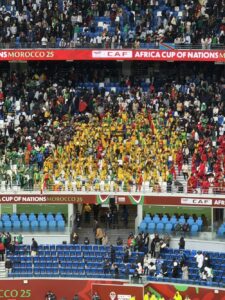
These dynamics extended into digital spaces, with racist discourses proliferating across Moroccan social media and Moroccan diaspora communities in Europe. These exchanges invoked imagery linked to slavery, colonialism, anti-blackness, racial superiority, and archaic accusations of witchcraft. Institutionally, tensions were unprecedented; the Senegalese coach’s post-match press conference was canceled amid confrontations and unprofessional commentary from Moroccan journalists, and videos circulated showing violent security interventions against Senegalese fans celebrating their team’s victory. Arrests, passport confiscations at airports, and the dismissal of a Burkinabe worker for publicly supporting Senegal further illustrated how racism escalated from individual behavior to institutional practice, rendering sports celebrations themselves politically charged acts.
Earlier, the opaque circumstances surrounding the deaths of a Malian journalist and a Cameroonian fan during the tournament in Rabat, with no transparent official accounts, had fueled social media outrage. Later Morocco authorities pronounced the journalist had died of natural causes.
What emerged from the Africa Cup of Nations underscored the political instrumentalization of sport, racialized power relations, and weak accountability, illustrating how inequality and exclusion are structured through internal configurations of power. The power and credibility of the Confederation of African Football (CAF) is on trial here too, despite the remarkable journey since the founding of the AFCON in 1957 in Khartoum, Sudan.
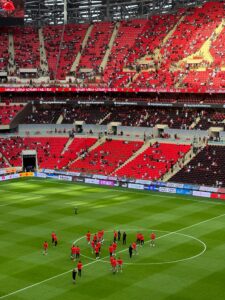
Football and Political Whitewashing
Political whitewashing is one of the main tools used by neocolonial and dictatorial regimes to invest in narratives and optics that maintain domestic legitimacy and enhance their international image, while covering up underlying systems of dependency and/or authoritarian rule. It refers to the deployment of major sports and cultural events as symbolic instruments to reshape power narratives, deflect attention from structural abuses, and project the image of a “modern” and “open” state on the global stage.
In this context, Morocco’s investment in football illustrates how political whitewashing operates in practice. International tournaments and sporting narratives are mobilized to project stability and claims of African leadership, positioning sport as a diplomatic and symbolic tool that obscures economic inequality, structural racism, and political dependency. Football’s symbolic power—its ability to mobilize emotions, cultivate affective belonging, and consolidate national narratives—allows athletic success to function as a substitute for political legitimacy.
This dynamic prioritizes national prestige over social justice, reinforcing political whitewashing as a strategy that diverts attention from systemic oppression while sustaining the state’s image as capable, modern, and legitimate. These tactics have been used for decades, with recent examples being Saudi Arabia, Qatar and the World Cup, United Arab Emirates and the NBA, Rwanda and Basketball and other sports ventures, and Donald Trump getting a special ‘peace prize’ ahead of the World Cup despite his ongoing violent and imperialist policies.
There is a close link between Morocco’s political whitewashing and neocolonial power on the continent. Morocco’s investment in football is not only about improving its image, but also about presenting itself as a dependable partner in controlling the African space in the interests of imperial powers, especially Europe— a role further consolidated by its co-hosting of the 2030 FIFA World Cup with Spain and Portugal, making Morocco only the second African country to host the tournament after South Africa in 2010. Sporting tournaments are framed as proof of “institutional readiness” and “security capacity,” thereby strengthening the state’s image as capable of managing crowds, controlling populations, and securing borders in line with the expectations of the international order.
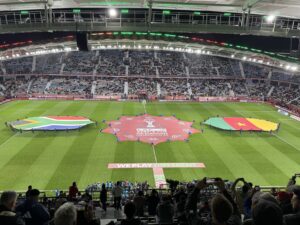
Within this context, Africa itself is used as part of the whitewashing narrative. Hosting the Africa Cup of Nations is presented as evidence of “commitment to Africa” and “continental solidarity,” while at the same time, racist and exclusionary policies are practiced against Africans from other countries during the tournament. This contradiction reflects a renewed colonial logic, one that strips Africanist discourse of its liberatory meaning and redeploys it within a framework of imagined dominance and superiority over Africans.
The tournament exposes the fragility of political whitewashing. These efforts are directed primarily toward imperial centers, while engagement with Africa remains framed by a colonial and racialized mindset that positions Africans as subordinate, responsible for failures, and expected to overlook corruption, mismanagement, or attempts to monopolize the event. Such dynamics reveal how political whitewashing preserves external prestige while maintaining internal hierarchies of power and exclusion, highlighting the persistent gap between official narratives and lived realities.
Enter the Occupation of Western Sahara
Issues such as racism, chauvinistic nationalism, political whitewashing, and Morocco’s place within the neocolonial system cannot be understood without putting the occupation of Western Sahara, known as Africa’s last colony, at the center. This occupation is the main structure through which Morocco’s role within the imperial system in Africa is formed.
The roots of the Western Sahara issue lie in the Sahrawi people’s resistance to Spanish colonialism, which began after the 1884 Berlin Conference placed the territory under Spanish rule. Spain governed Western Sahara through exploitation and resource extraction, and the Sahrawi people fought back. The anti-colonial struggle culminated in the formation of the Popular Front for the Liberation of Saguia el-Hamra and Río de Oro (POLISARIO) in 1973. POLISARIO advanced a socialist liberation project that rejected economic and political dependency and linked national liberation to social emancipation, asserting the Sahrawi people’s right to self-determination and control over their resources within a broader African liberation vision.
As Spain prepared to withdraw and the Sahrawi people refused compromise, regional and international powers moved to contain this project. The 1975 Madrid Agreement divided Western Sahara between Morocco and Mauritania, disregarding Sahrawi consent and replacing decolonization with occupation aligned with U.S. and European interests. This was followed by Morocco’s military invasion, marked by repression, mass displacement, and systematic resource plunder.
This role is essential for understanding the discourse of Moroccan “superiority.” This sense of superiority is not based solely on history or culture, but also on its current position in the geopolitical imperial power order. Morocco is presented as a “stable state,” a “security partner,” and a “gateway to Africa,” labels that are directly linked to its role in policing the region, containing liberation movements, and blocking the emergence of revolutionary and sovereign alternatives.
Morocco’s occupation of Western Sahara has served as a strategic gateway into Africa, allowing it to control key land and sea access to West Africa and position itself as a reliable actor in regional affairs. Morocco exited the African Union in 1983 and only returned in 2017 to reinforce this strategy. Moreover, Morocco’s security cooperation with Israel must not be overlooked, as it advances surveillance and intelligence sharing, reinforces this strategy by using the occupation to suppress Sahrawi resistance and consolidates control over the territory’s strategic location and resources. This partnership supports a broader Zionist–Western model of proxy domination in West Africa, combining settler-colonial practices and technological tools to extend control across the continent and its resources.
Events at the Africa Cup of Nations and the post-final fallout reveal how Morocco’s role as a neocolonial agent, reinforced through its occupation of Western Sahara and strategic alliances with other neocolonial regimes on the continent, shapes both domestic and regional dynamics. Western Sahara’s resources and location are central to this system of proxy domination, linking settler-colonial practices and technological control to broader African influence. Understanding these realities could go a long way to strengthen solidarity with African liberation struggles and challenge the narratives that justify domination—not only in Western Sahara, but across the continent.
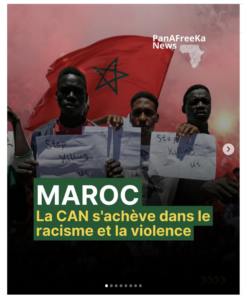
The pushback in the media and digital spaces from the rest of the continent and the diaspora against Morocco during AFCON2025, therefore, cannot be seen purely as a football rivalry. Football is political, and AFCON’s birth was rooted in African anti-colonial resistance. Football arenas and discourse, therefore, cannot be divorced from the continent’s political and economic realities and contestations. Morocco will host the WAFCON – Women’s Africa Cup of Nations, which also serves as a World Cup qualifying tournament, in March. This debate must continue!
Feature photo by CAF
Souad.S is a Pan-African feminist from occupied Western Sahara. Her work focuses on grassroots organizing and political education against colonialism, capitalism, and racism and other forms of oppression.
Brilliant and very insightful article!