
The Law Society of Kenya (LSK) is preparing for a new president following the end of Faith Odhiambo’s two-year, non-renewable term. There are three candidates in the race for the 52nd President of the LSK, namely Mwaura Kabata (incumbent Vice President), Peter Wanyama, and Charles Kanjama. On Thursday, 19 February 2026, lawyers will have to make a critical decision.
Why LSK presidency is important?
The LSK Presidency leads lawyers in Kenya in performing three critical roles: self-regulation of the profession; protection of the constitution and the rights of minority groups; and securing public legitimacy. Section 4 (b) of the Law Society of Kenya (LSK) Act mandates it to “uphold the Constitution of Kenya and advance the rule of law and the administration of justice” while Section 4 (d) mandates it to “protect and assist the members of the public in Kenya in matters relating to or ancillary or incidental to the law” Past LSK Presidents have played key roles in safeguarding human rights and democracy in Kenya.
For instance, under Faith Odhiambo’s Presidency, we observed critical efforts to safeguard the rights of victims of state excesses during protests in 2024 and 2025. Paul Muite’s presidency in 1991/92 was essential in the “Struggle for the Second Liberation” and the fight for multi-party democracy. The LSK Presidency can, therefore, make or break crucial constitutional moments and elevate or derail state obligations to protect human rights. The LSK President also plays a key role in regional and international bar associations, including the East Africa Law Society, the Pan African Lawyers Union, and the International Bar Association, where they contribute to the development of key regional and international human rights frameworks.
A look into Charles Kanjama
Charles Kanjama is a Kenyan High Court advocate. Behind the veneer of an accomplished lawyer, he has cultivated his place as an anti-rights ideologist who works closely with global right-wing groups to dismantle constitutional safeguards and human rights protections for Kenyans and Africans. Here is why his candidacy is a poisoned chalice for the constitution, the legal profession, the country, and the continent.
In 2010, Kenya adopted a transformative constitution that heralded a new era of democratic devolved governance, entrenched a comprehensive bill of rights, and anchored oversight in independent institutions. At the time, Charles Kanjama was an advisor for the “no camp” during the clamour for the 2010 Constitution. He labelled the Constitution as problematic and in need of amendments. He expressed concerns regarding the human rights chapter, sovereignty, the land chapter, devolution, and the structures of the executive, legislature, and judiciary. Guess who else was in the No camp? Current President William Ruto, whose government is accused by civil society organisations of intimidation, harassment, and threats.
No support for Gen Z protests and public accountability
In June 2025, thousands of Kenyan youth protested the government over a range of proposed high taxes on essential goods and services under the auspices of the #RejectFinanceBill movement. Excessive use of force by security agencies resulted in at least 128 deaths, 3,000 arrests and over 83 enforced disappearances. Legal intervention proved important as extrajudicial arrests and detentions are a known tool of government repression. In this moment, while hundreds of lawyers showed up, Kanjama was silent and remains silent about the spate of extrajudicial killings, torture, and abductions steered by the current regime. If he has been silent when it mattered the most, how will the Presidency make him vocal? Kenyan citizens and lawyers should not expect a constitution-based rule of law and protections during his term.


Advocating for retrogressive constitutional amendments
In 2010, Kanjama established the Kenya Christian Professional Forum (KCPF) and, later, the African Christian Professional Forum (ACPF) as vehicles for advancing constitutional change. Since then, KCPF and Kanjama’s agenda has been anti-constitutional reforms. KCPF has proven a failure, especially in the courts of law and public opinion, which is why Kanjama is seeking the LSK Presidency for his retrogressive agenda, given that the LSK is credible and legitimate. KCPF has been deeply embedded in the anti-rights push to overturn hard-won freedoms of Kenyans and Africans using the narrow lens of religious morality as a basis for law. The ACPF, which hosted the Pan-African Conference on Family Values in May 2025, convened a group of white evangelical men to speak about African Family Values. The use of white evangelical missions to regress freedoms of Africans while cloaking the discourse in family values is an old colonial agenda.
Anti-Katiba Day and Anti-women, Anti-LGBTIQ legislation
Kanjama claims to have pushed for the recognition and commemoration of August 27th as Katiba Day (Constitution Day). Katiba Day is an important day for celebrating constitutional milestones and auditing missed opportunities. Kanjama and KCPF have turned it into an anti-katiba day where they push and give visibility to retrogressive constitutional amendment agendas, including the infamous March for Life, which seeks to advocate for the removal of constitutional protections of the right to safe abortion.
Kanjama and KCPF have been the nucleus of anti-abortion, anti-women and anti-LGBTIQ legislation in Kenya, including the Linda Uhai/Linda Jamii constitutional amendment initiatives; the Family Protection Bill 2023, the National Policy on Family Protection and Promotion 2023, and Kenya’s Reproductive Health Policy (2022–2032) that claw back at constitutional protections for women, queer people, and other marginalized groups. He failed to appear in Court or delegate in a critical appeal on grounds of being busy on the campaign trail. This Civil Appeal challenges section 162 (1) (c) and 165 (c) of the Penal Code that criminalises same-sex consensual sex. He doesn’t care that justice delayed is justice denied for queer people.
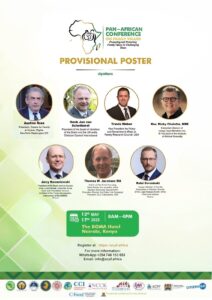
Pan African Conference on Family Values poster that sparked backlash in 2025
Revictimize survivors of sexual violence & Represents sexual offenders
As pointed out by the Coalition for Grassroots Human Rights Defenders – Kenya, Kanjama has a concerning litigation pattern of persecuting and retraumatizing victims of sexual violence while protecting powerful offenders accused of sexually abusing children. In a 2019 case of FIDA Kenya & Others v. the government a mother won compensation for JMM, who had been defiled at 14, procured an unsafe abortion and ultimately died. The High Court ruled that abortion is permitted for victims of sexual violence and individual reparations must be paid to JMM’s mother. KCPF, under Kanjama’s leadership, appealed against the decision, and seven years later, he is forcing the family to relive the trauma in court.
On the other end of the spectrum, in 2017, Kanjama appealed and secured the release of Father John Mutua Munyoki, a Catholic priest who had been sentenced to 15 years for defilement. In March 2024, he represented Father James Kimani Kairu of Eldoret Parish, accused of defiling an eleven-year-old child whom the priest had formally adopted. While under the cab rank rule, all clients are entitled to representation by an advocate, the types of clients Charles Kanjama defends versus those he prosecutes speak volumes. To paraphrase Rachel Mwikali on behalf of CGHRD, Kanjama’s mercy flows upwards to powerful men while his punishment flows downwards to vulnerable girls. The pattern of who receives justice in his cases and who is denied it should concern all Kenyans invested in holding power accountable.
Target Women’s rights protections in AU treaties and instruments
Charles Kanjama, in his capacity as the Chair of the Family Law Committee of the African Bar Association, has drafted model reservations to the African Union Convention on Eliminating Violence against Women (AUCEVAWG), urging Member States to weaken state obligations on ending sexual violence. His recent proclamations on addressing sexual harassment in the legal profession are thus empty PR promises. He has also pioneered the drafting of the African Charter on Family Sovereignty and Values, which seeks to restore traditional gender roles for women within the family and to weaken existing provisions on equality in marriage and the family in Africa.
Make America Great Again (MAGA) group connections
Through ACPF and KCPF, working closely with American religious right-wing groups such as Family Watch International and Christian Church International, among others, Kanjama has sought to influence constitutional amendments, legislative changes, and policy enactment to weaken human rights protections for vulnerable groups. The rise of right-wing white supremacist groups in America has already had debilitating impacts on the lives of racial minorities, migrants, women and Queer people in America, and the building of branches through people like Kanjama is a threat to self-determination and the struggle for equality in our countries and across the Pan African diaspora.
Given this history, Charles Kanjama is therefore incapable of serving as an independent LSK President. Given his proximity to the Executive and to Parliament’s leadership, it is doubtful that Kenyans can be defended under his leadership.
The next LSK President will have to steer the country through the anticipated tumultuous 2026-2028 election cycle, during which a repressive incumbent is seeking a second term by any means. Electing Charles Kanjama as LSK President will equate to giving him a no-holds-barred platform to execute his anti-constitution, anti-people, and anti-rights agenda. His ideological alignment with President Ruto is concerning. His campaign slogan “Wakati umefika. LSK ya wote” (Time is ripe. LSK for all) rings hollow for women and queer advocates as his anti -rights advocacy continues to malign and marginalize them.
Charles Kanjama’s personal ideological religious views and need to fight for all people of Kenya as a law society presidency demands are incompatible. He has no record of holding the state accountable for human rights violations. He lacks the independence needed to check the state’s excesses during the fragile pre-election, election, and post-election period from 2026 to 2028. His links and work with anti-rights groups wreaking havoc on Africans, migrants and marginalized communities in America should be taken seriously as the transnational nature of the regression of rights is well documented. Kenya, Africa, and the world will be a better place if Kenyan lawyers do not elect him to be the LSK President.
Feature photo by Photo by MC G’Zay
Authored by Concerned Pan-African Feminist Human Rights Lawyers:
1. Deborah Nyokabi
2. Achieng Orero
3. Nerima Were
4. Beatrice Njeri
5. Nyokabi Njogu
6. Elsie Milimu
7. Joy Awich
8. Tracey Lichuma
9. Winfred Odali
10. Ebby Mokaya
11. Marion Ogeto
12. Yvonne Abungu
13. Laura Kerubo Ongoto
14. Olendo Obondo
15: Cherop Menjo