It was the end of 2025, that in-between stretch of the year when offices begin to wind down, group chats fill with “last meetings,” and people speak as though life will slow down by itself. Nairobi rarely does. The traffic stays busy, the days still feel full, and plans continue stacking, one on top of another.
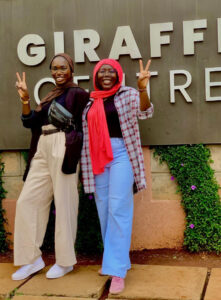
Then an invitation to a small gathering from a feminist organisation arrived, which I honoured. I show up when such doors open, partly out of curiosity and partly because I want to be in rooms where women are thinking publicly about power and dignity. I went with my sister. My sister is not the kind of woman who “tries” to look put together; she simply is. She has a clear sense of fashion and style and carries herself with a quiet steadiness. I mention this because clothing is often treated as a kind of evidence, and in her case, people tend to draw conclusions quickly. That day, she wore a full abaya (what many of us call a buibui), a black cloak, with a scarf. It was a simple, practical, neat outfit that made her visibly Muslim in a way people instantly recognised.
As we settled in, the organizers asked everyone to do a familiar exercise: turn to the person next to you and begin a conversation. I was already talking to friends from our group. My sister was seated beside a young woman around her age. The young woman was also Muslim, but she did not cover her hair. In another context, this would have been a minor detail. In that room, it seemed to matter more than it should have.
My sister turned to her politely. I wasn’t paying close attention until I sensed my sister shift slightly. Later, she told me what happened. Before they could exchange names, the young woman leaned toward someone else and asked if she could talk to them instead. Then, within earshot, she added that she did not know what she would talk about with my sister.
“Are we going to talk about cooking mahamri?” she said, referring to my sister.
Mahamri is a coastal, Swahili food that many of us love. In our homes it is part of celebration, hospitality, and memory. In that moment, it was used as a way to shrink a person. It was not a comment about food. It was a comment about who the speaker believed my sister could be. A coded way of saying: You are limited; your world is domestic; your mind is small; your life is only kitchens and kneading and obedience. And because Mahamri is tied to the Kenyan coast, where many Kenyan Muslims live, the comment carried an extra sting: that familiar conflation of Muslimness with backwardness, of hijab with a lack of sophistication and modernity and of faith with a lack of intellect.
And the irony was that my sister is a whole software engineer, a photographer, an all-rounder with multiple languages of competence, the kind of woman who can debug a system and frame a portrait and still show up in a buibui that people insist on reading as a sign of oppression. Not that her résumé should have been required at all. A woman should not need credentials to be treated with basic respect and dignity. If my sister were not an engineer, if she were someone whose work is entirely domestic, she would still deserve to be approached as a full person.
So what do we call this, when it doesn’t fit the neat “usual” script?
We often define Islamophobia as fear, hostility, or prejudice toward Islam and Muslims—something that can operate socially, structurally, even systemically. One widely cited genealogy traces the term to a Runnymede Trust framing of “unfounded hostility towards Muslims,” while scholars and research centres also emphasise Islamophobia as a power-producing system: a “contrived fear or prejudice” that positions Muslims as a threat and then justifies exclusion and control.
But what happened in that room felt both familiar and different: it wasn’t the “expected” Islamophobia that people imagine as something only non-Muslims do; it was something more intimate, more socially contagious, more insidious—prejudice that travels within communities, and bias that can be performed by people who share your faith but have absorbed the same hierarchies that harm you.
There are names for this. One is gendered Islamophobia: the particular way anti-Muslim bias attaches itself to women’s bodies, clothing, and visibility, producing stereotypes of the hijabi woman as oppressed, unintelligent, suspicious, or in need of rescue. Another is hijabophobia, a term used to describe hostility and discrimination specifically targeted at women who wear the hijab or other forms of Islamic covering—because the cloth becomes an over-read symbol onto which strangers project fear, pity, contempt, or control. And then there’s the part that explains why a fellow Muslim woman could still weaponise that stereotype: internalised Islamophobia—the phenomenon where Muslims themselves ingest and reproduce negative ideas about Islam and Muslim identity, often unconsciously, because those ideas have been normalised by society, media, and “respectability” narratives for so long that they start to feel like common sense.
So yes: it can be Islamophobia, and it can be misogyny, and it can be classed assumptions about “modernity.” It can be internalised prejudice wearing a familiar face, and it often shows up as a microaggression so casual it expects you to swallow it without naming it.
A slow realisation: I had been living inside the pattern all along
After the event, I started paying attention in a way I had not before. Not in a dramatic way, but more like noticing a sound in the background that you can no longer ignore. I thought about the places where I have felt invisible until I speak. I thought about how often hijab changes the tone of an interaction before the first sentence is exchanged.
I had a conversation with a close friend of mine who is Muslim but does not wear a hijab. We have attended restaurants and events together many times. I asked her directly if she notices any difference in how we are treated.
She answered without hesitation.
“Since you wear hijab, people assume you’re dumb until you start speaking,” she told me. “That’s when they realize you’re brilliant.”
She did not say it to frighten me. She said it as if it were something she had long accepted as part of how social spaces work. She also said she assumed I already knew. I did not know in a fully conscious way. I knew in fragments: the way a waiter looks past you, the way a host directs explanations to someone else, the way you have to work slightly harder to be seen as competent. It is not
And then it clicked why certain “compliments” have always felt like a slap in the face. I remember being told, years ago, You’re too smart for a Muslim lady, the kind of statement that pretends admiration while revealing the low expectation underneath: the assumption that Muslim women—especially covered Muslim women—are naturally less intelligent, less capable, less complex. These are not compliments. They are soft dehumanisations, delivered with a smile.
Even at international borders, I have seen that the pattern can become policy-adjacent: the “random checks” at immigration that stop feeling random when you notice who gets selected, who gets scrutinised, whose body is read as risk because her faith is visible. Gendered Islamophobia is not only interpersonal; it is also something that can be intensified by securitisation, surveillance, and the political theatre of suspicion that has shaped Muslim travel for decades.
I do not owe anyone an explanation to be treated like a human being
At the centre of all this is a simple feminist truth: my dignity is not conditional. I should not have to narrate my choices, why I cover, how I cover, or whether I cover to earn basic respect. My scarf is not a CV. My abaya is not an invitation to test my intelligence. My faith is not a prompt for strangers to ask whether I’m liberated, oppressed, radicalised, submissive, or naïve.
And this is where feminism that isn’t intersectional either becomes real, or it becomes another institution that polices women in a different language. Because if feminism cannot recognise Muslim women’s agency, both the agency to cover and the agency not to cover, then it becomes a narrow project that mistakes sameness for freedom.
The far-right “liberation” myth and Muslim women’s bodies as a battlefield
There is a particular performance of concern that shows up whenever hijab is mentioned, especially in global conversations: the claim that Muslim women must be “liberated” by removing the hijab, as though freedom is something you can deliver by force, as though autonomy is compatible with coercion, as though women’s bodies are public property that states, pundits, and strangers can manage.
Mona Eltahawy, Egyptian author, has a line that cuts through this hypocrisy: “Unless you’re a Muslim woman, shut the fk up and listen to Muslim women.” Her point isn’t that only Muslim women can speak about patriarchy; it’s that when the entire debate turns into everyone talking over Muslim women using them as evidence, as warnings, as moral theatre, what gets erased is the actual lived complexity of Muslim women’s lives. Eltahawy names the trap with brutal clarity when she says debates about how Muslim women dress “really excite racists and Islamophobes,” and that Muslim women are pushed between “a rock and a hard place”, the rock of racist, Islamophobic agendas and the hard place of misogyny within communities.
And then she offers the metaphor I keep returning to, because it describes the feeling perfectly: “The body of Muslim women is like a blackboard where everyone leaves their message.” That is what this obsession is. It is not about saving Muslim women. It is about using Muslim women’s bodies as a stage for other people’s politics.
This is why the same world that demands hijab be removed “for freedom” can also turn around and tolerate or strategically ignore contexts where women are forced to cover, because the outrage is often less about women’s autonomy and more about whose ideology gets to win.
Forced veiling and forced unveiling: Different uniforms, same control
If we are honest, the global story is not “hijab vs no hijab.” The story is control vs choice. In Iran, for instance, the state’s enforcement of mandatory hijab has been repeatedly documented as part of a broader architecture of repression against women’s autonomy; UN investigations have described escalating surveillance and punitive measures targeting women who defy compulsory hijab rules, especially in the aftermath of the “Woman, Life, Freedom” protests that erupted after Mahsa Jina Amini died in custody in September 2022.
In Afghanistan, the Taliban’s gender apartheid has been built decree by decree, shrinking women’s lives until public space itself becomes forbidden, and recent reporting has highlighted rules that go beyond clothing into the policing of women’s voices and movement—restrictions that make women’s visibility and audibility a punishable offence. These are not “cultural quirks” but rather patriarchal projects; projects that treat women’s bodies as territory, and hijab as governance, and silence as virtue.
And on the other side of the globe, the demand to remove Muslim clothing in the name of “secularism” can mirror the same logic of control: when a state decides what a woman may wear, it is still deciding that her body is not fully hers. The uniform changes, but the ideology rhymes. That’s why Eltahawy also warns against simplistic rescue fantasies, saying it is “too easy and privileged” to tell women to abandon religion to free themselves, because patriarchy exists both inside and outside religious structures. Feminism that understands power cannot support coercion in any direction; it has to defend autonomy, not aesthetics.
A harder mirror: Biases we carry, even when we think we’re free of them
What shook me most about that Nairobi event wasn’t only the insult; it was the reminder that bias is contagious, and that we can carry it without realising, absorbing it from school systems, media narratives, class signalling, respectability politics, colonial hangovers about what “modern” looks like, and patriarchal myths about what “intelligent” sounds like. Internalised Islamophobia is not a personal failure; it is a social symptom—what happens when a community is pressured long enough to distance itself from the parts of itself that the world mocks.
And if we’re doing feminism seriously, we have to be brave enough to name this: sometimes the prejudice is coming from inside the room—from women who have learned that proximity to “acceptable” womanhood buys safety, and that visible Muslimness costs social value, and that the easiest way to climb a hierarchy is to step on the women the hierarchy already marked as inferior.
So the question becomes: Who do we unconsciously consider respectable? Who do we assume is intelligent? Who do we treat as background until they prove they deserve the microphone? Because those questions expose the quiet architecture of our bias.
Solidarity that isn’t selective—and a feminism that actually listens
When I see hijabs burned in solidarity with Iranian women, I understand the rage against forced veiling, the refusal to let the state own women’s hair, skin, and breath; I understand the symbolism. But I also think solidarity has to be ethically consistent: if your empathy is loud only when a story flatters your worldview if you can mobilise for one group of women while remaining silent for Sudanese women, Palestinian women, or any other women living under violence and dispossession then what you have may not be solidarity so much as performance, a politics of selective visibility.
And when it comes to hijab, the baseline should be simple: Muslim women should be the ones centred in conversations about Muslim women’s dress, not because others have nothing to contribute, but because anything else turns into the same old project—talking about Muslim women as objects rather than subjects, as symbols rather than people. Or, to borrow Eltahawy’s insistence in a softer translation: stop using Muslim women’s bodies as a blackboard for your ideology—make room for Muslim women to write their own messages.
I want a world where a scarf is just a scarf
I want a world where my sister can wear a buibui and be met first as a human being, not a stereotype; where a hijab is not treated like an intellectual limit; where mahmari can be what it is—food, culture, joy—without being weaponised as a lazy insult; where the covered woman and the uncovered woman are not ranked on a ladder of respectability; where “feminist spaces” do not reproduce the same hierarchies they claim to dismantle.
And until that world exists, I will keep naming what I see: gendered Islamophobia, hijabophobia, internalised Islamophobia, and the patriarchal impulse, both global and local, to treat Muslim women’s bodies as a battleground. The point is not whether I cover or not; I should never have to translate my humanity into something more “palatable” before I am treated with dignity.
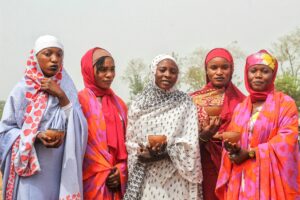
Feature photo of women with headscarves taking a walk in Zanzibar by Qarim Zam
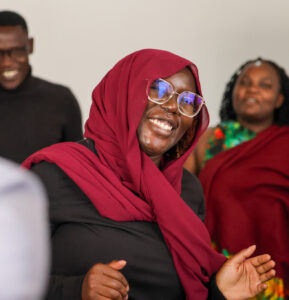 Amisa Rashid is a mental health practitioner and neuropsychologist whose work focuses on the intersections of community, identity, and wellbeing. As the Founder and Executive Director of the Nivishe Foundation, she leads initiatives that provide culturally grounded and non‑discriminatory mental health support to underserved communities. Her work is rooted in a commitment to decolonizing and Africanizing mental health care.