What is mutual interest in an unequal world? That’s what I was reflecting on this week in Brussels, when I joined the “Mutual interests in practice: How should Global Europe balance development, economic and geopolitical objectives?” panel at The Future of EU Development Cooperation, hosted by the European Centre for Development Policy Management (ECDPM) and Oxfam. The discussion came at a decisive moment, as the EU negotiates its next long-term budget and the Global Europe Instrument, while the Commission prepares for consultations with civil society and local authorities from 28 September to 1 October. Regional sessions include “Sub-Saharan Africa”, while global thematic sessions cover human development, the green and digital transition, democracy and human rights, and partnerships.
The EU is pivoting development cooperation towards its own economic, security and foreign policy goals through a “mutual interest” approach. But mutual interest means little unless it confronts the unequal systems that determine whose interests count, whose risks are ignored, and whose lives are rendered negotiable.
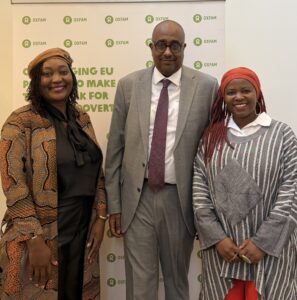
I spoke alongside H.E. Dr Naomi A. Ngwira, Ambassador of Malawi; Martin Seychell of DG INTPA; Christophe Lam of BusinessEurope; and William Roos of the EBRD, in a discussion moderated by San Bilal of ECDPM. I drew on the Afro-feminist work of the AfIP Collective, including members such as Memory Kachambwa of FEMNET, who also made a presentation, and the work of many African feminists challenging foreign policy in a time of faltering multilateralism.
For many in Africa, the EU’s pivot offers little that is new. Europe has repackaged its approach to Africa without altering the fundamentals that produce inequality. The Global Gateway has, by the EU’s own count, mobilised over €300 billion since 2021, including an Africa–Europe package of around €150 billion, and now targets €400 billion by 2027. But mutual interest is not mutual benefit: interests may overlap while benefits, risks and decision-making power remain profoundly unequal. As San Bilal writes in a new ECDPM briefing, wrapping every project “in a cosy mutual-benefit narrative is misleading.”
Africans have long critiqued, opposed and contested donor narratives and models of development financing and aid, calling for partnerships that are accountable and mindful of historical context. The pivot towards capital investment, with the private sector presented as the new magic formula, does not account for the reforms needed in relationships that remain hegemonic, rooted in a long history of colonialism and racial capitalism. Investment language alone forgoes critical responsibilities rooted in reparatory justice for the continent’s historic underdevelopment and exploitation.
The next Global Europe Instrument won’t escape imbalances. In its recommendations to the Irish Presidency, Oxfam warns that an explicit mandate to pursue EU interests “places excessive emphasis on the EU’s priorities over partner country objectives.” Development funding could build infrastructure for extracting critical raw materials, often for European firms and export, a trend “particularly visible on the African continent.” Fragile and conflict-affected states, which offer investors little, risk falling off the EU’s radar: left to their own devices, or pushed into extractive investment models that can deepen the very conflicts they need to escape.
Decolonial Afro-feminist perspectives argue that decisions and seemingly new approaches to trade, finance, security and cooperation are made within an existing unequal global order, its structures and relations, which distribute power, risk and harm unevenly. Who defines the bargain, whose trade-offs are treated as inevitable, and who is disposable before negotiations begin? In systems built to drain value from Africa, the same deal benefits Europe while Africa bears the costs. As economist Fadhel Kaboub warns, the colonial division of labour “locks you permanently at the bottom of the global value chain.”
Too often, “mutual interest” also means the interests of ruling elites: mineral agreements whose costs fall on neighbouring communities, and migration deals that serve regime survival. Amid the war in eastern DRC in 2024, the EU signed a raw materials agreement with Rwanda, which UN experts have found to back the M23 rebels. Several EU states are now in talks with Uganda and Rwanda to host “return hubs” for people deported from Europe. This is the latest piece of an EU asylum overhaul that deepens years of border securitisation, in which deals worth millions have pushed Europe’s frontier into North Africa and the Sahel, wreaking havoc on people on the move.
This is unfolding as civic space shrinks, with governments invoking sovereignty to pass laws that silence critical voices. As foreign powers use capital to advance their interests in the rush for critical minerals, scrutiny of business and human rights matters more than ever: binding due diligence, free, prior and informed consent from communities, and protection for those who speak out.
EU deals cannot buy back what extraction has taken. We have seen the EU sign “mutual” agreements to stem migration from West Africa, even as decades of extracting its minerals and fisheries have drained local economies and pushed people into dangerous cycles of migration. A 2025 study, for example, found that subsidised European and Chinese fleets took half of Senegal’s catch over seven decades, costing women in fishing families their livelihoods and pushing families onto the deadly Atlantic route. A new European approach would make sense if it ended harmful subsidies and advanced greater transparency.
On climate, it remains unclear how the new approach will address climate finance that is already failing Africa: too little, too late, and too often in the form of loans. Europe should pay its fair share of adaptation finance as grants, as reparatory climate justice. Building on last year’s Seville commitments, global financing for development and reform of the international financial architecture are key. Europe should back debt relief without austerity and support the Africa Group’s UN tax convention while closing channels for illicit flows. On trade, it should end rules that allow Europe to subsidise its farms while opening African markets, and support the AfCFTA. It should also work towards ending the colonial monetary system of the CFA franc, which impoverishes African countries.
At the event, Dr Gamal Eltaib Ibrahim of the UN Economic Commission for Africa spoke about turning the Seville commitments into delivery under African ownership: financing the AfCFTA, lowering Africa’s cost of capital and keeping sight of the SDG targets, many of which private capital alone will not advance quickly. He emphasized that “mutual interest between Europe and Africa cannot be assumed, it must be jointly defined, with Africa’s development priorities and structural transformation at the centre.”
Kachambwa pointed out that amid immense attacks on gender justice work by far better-resourced anti-rights networks, any new global European direction should not abandon human rights obligations, both at home and in partnerships. She raised the magnitude of human rights and labour violations against African communities in areas where the extraction of minerals fuels conflicts and sexual violence and called for a gender just Europe instrument that protects the most vulnerable beyond their borders.
The digital economy follows the same extractive pattern: as the Nawi Collective’s Between the Cloud and the Commons shows, the cloud runs on Congolese cobalt, African content moderators, and dumped e-waste. Europe’s digital laws should address these global inequities, not only how technology is deployed and consumed in Europe. EU members’ involvement in Africa digital public infrastructure projects should not undermine independence or replicate the sovereignty compromises that already exist. The EU must improve its digital policy to support international digital governance processes that equally protect, stem e-waste dumping, and ensure a human-centred digital future in the face of techno-capitalism.
How Europe spends has never mattered more. We are in the midst of rising militarism and swelling defence budgets, alongside a far-right that exploits migration to polarise and score political gains, and that deploys anti-gender ideologies. Together, these trends make this a deeply concerning moment for Africa, as global powers compete loudly for African resources, including land, water and minerals.
We need far more decent jobs, gender equality, transparency, local value creation and locally led development. We also need far greater concern for social sectors such as healthcare, education and social protection, which require public capital more than private investment. These falter when the mutual interests of foreign powers align with those of ruling elites, without accountability and transparency. The EU has been at the core of constructing and upholding an unequal world order rooted in extractivist systems in which African lives and resources are not of equal value. Will its new focus on its own security and economic interests, short- and long-term, ever bring about a more equal world?
African civil society, media, intellectuals and social movements must continue to scrutinise and push their governments to address these global shifts to end systems of extraction, rather than prioritising short-term survival goals and infrastructure that leave the unequal world order intact. The question is whether these shifts make African women, young people, queer communities and impoverished regions safer, freer and better resourced. The answer lies beyond projects; it is in how far new approaches to engaging with Africa are committed to dismantling the oppressive global systems that uphold inequity.
