
On March 26, 2026, after an executive board meeting in Lausanne, Switzerland, the International Olympic Committee (IOC) released a 10-page policy: “Protection of the Female (Women’s) Category in Olympic Sport.” This policy bans transgender women and restricts athletes with Differences in Sex Development (DSD) from women’s events, starting with the 2028 Los Angeles Olympics. The IOC frames this as a matter of fairness and safety. Yet this policy is scientifically dubious, historically discredited, and racially coded. African nations should be concerned and resist.
What the Policy Actually Does
The new rules allow only “biological females” in women’s events. Eligibility is determined by a one-time SRY gene screening, where the SRY gene is a genetic marker typically found on the Y chromosome and associated with male biological characteristics. Any athlete with the SRY gene is deemed ineligible. The IOC describes the test as non-invasive, requiring a cheek swab or blood sample. Athletes who screen negative permanently meet the eligibility criteria. Those ruled ineligible may compete in male events or in sports that do not use sex-based classification.
IOC President Kirsty Coventry from Zimbabwe, the first woman to lead the Olympic body in its 132-year history, said: “It is absolutely clear that it would not be fair for biological males to compete in the female category.” The IOC acknowledges “rare exceptions” for athletes with Complete Androgen Insensitivity Syndrome (CAIS), but has not explained how athletes would access that exception or appeal a decision. Women with partial androgen insensitivity or other variations face exclusion despite having been identified as female at birth.
Over 100 human rights organisations have described this as “an astounding rollback on gender equality” that could “set women’s sport back 30 years.”
The reliability of the SRY test is highly contested. At the 1996 Atlanta Olympics, eight women failed the same test but were later reinstated. This prompted the IOC to abandon mandatory sex testing then. Andrew Sinclair, the geneticist behind the SRY gene’s discovery in 1990, explained that the test only shows whether the gene is present. It does not indicate how the gene functions.
Rights advocates say the policy invades women’s privacy, giving up personal medical and genetic information for the IOC to determine “if they are ‘woman enough’ to compete.”
The political context is impossible to ignore. The policy is similar to a U.S. executive order issued by President Donald Trump in February 2025 banning trans women from women’s teams, and the White House has congratulated the IOC’s decision.
Transgender athletes are underrepresented in sports due to eligibility rules, legal barriers, stigma, and fear of discrimination. Very few reach the elite level. While some organisations have suggested a third or open category, it is unlikely that transgender women and girls would participate under these conditions. Women and girls with intersex variations also face serious risks, including invasive exams, unnecessary treatments, and increased stigma due to mandatory genetic sex testing.
A Step Backwards
The IOC abandoned universal sex testing after the 1996 Games, deeming it scientifically and ethically unjustifiable. The,
United Nations High Commissioner for Human Rights, UN Women, the World Medical Association, and the American Medical Association have all long condemned sex testing as discriminatory, unethical, and harmful. Now, thirty years later, the committee has reversed course. A group of independent UN human rights experts issued a joint statement warning that “the human rights principles of equality and non-discrimination, respect for human dignity, bodily and psychological integrity, privacy, and access to an effective remedy” are directly relevant to sporting bodies whose rules have “direct and foreseeable human rights impacts.”
They stated that “mandatory genetic sex testing and blanket bans raise serious human rights concerns,” that such regimes risk reintroducing discrimination and that scientific uncertainty should favour inclusion, with eligibility rules that are “demonstrably necessary, proportionate, and grounded in sport-specific evidence.”
The experts also highlighted the problem of opaque deliberations within sports bodies. The composition, mandate, and working methods of the advisory groups have not been disclosed. They called for transparency and meaningful engagement by affected athletes. On redress, the experts said mechanisms are inadequate. Athletes must use mandatory arbitration before the Court of Arbitration for Sport. But barriers and costs cast doubt on whether these protect fundamental rights.
More Than Sex and Gender: The Racial Dimension
Scholars such as historian Susan Cahn and scientist Anne Fausto-Sterling have noted that historically, sex testing in sport was driven by racial anxieties about the success of Black and Global South women, with policies evolving from anatomical checks to molecular scrutiny. These regimes, many argue, have framed natural variation as suspect and have justified the monitoring or exclusion of certain athletes. This especially affects women from the Global South, and has justified their exclusion from “civilised” roles. It’s not just the Olympics, FIFA’s 2011 gender verification policies prioritised androgen levels, and World Athletics rules that have been shifting goalposts over the years, treating natural biological traits as deviant. Sports bodies continue a tradition of using questionable medical authority to decide which women are accepted as women.
These rules might deter some women from competing, as they could be forced to choose between submitting to testing and risking disqualification—circumstances that may be experienced as coercive, even if formal consent is obtained.
In Female Testosterone: Contested Terrain, feminist, cultural and sports researchers argue that narrow definitions of female eligibility create “contested bodies” in elite sport, where women with naturally elevated testosterone “are being treated as if they are cheating.” They contend that deeming high testosterone an unfair advantage “is consistent with dominant cultural narratives rather than the research about testosterone and sport performance.” The authors highlight that “governing bodies, most of whom are powered by (white) western bias, construct and enforce narrow definitions of eligibility despite contested evidence,” raising concerns about “privacy, bodily autonomy, and unequal treatment,” particularly for “athletes of colour.” They further argue that “no sport is biologically ‘fair’ to begin with,” noting that bodily differences “are often left unquestioned and celebrated when they produce success (e.g., Michael Phelps’ wingspan), but problematized in women’s sport when they don’t conform to Eurocentric femininity ideals and expectations.”
There is a consistent pattern of African women being singled out after achieving success in elite sports. For example, Caster Semenya, an Olympic champion from South Africa, has faced intense scrutiny and exclusion, which she has fought in courtrooms for over a decade.
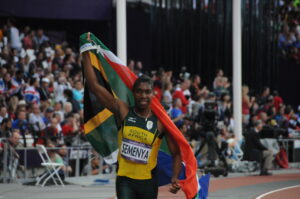
Responding to the policy, Semenya said, “I have carried this weight, as have other women of color who expected different treatment from sport. Reintroducing genetic screening is not progress — it is walking backwards,” adding, “This is just exclusion with a new name.”
Such outcomes reveal how race and regional origin intersect with sex testing regimes, reinforcing exclusionary effects, yet there was no consideration of the decades-long experiences of athletes who have been impacted.
Namibian sprinters Christine Mboma and Beatrice Masilingi, both 18, were ruled ineligible for the Tokyo 2020 Olympics. Zambian footballer Barbara Banda faced gender-eligibility assessments at the African Women’s Continental tournament (WAFCON 2022). Algerian boxer Imane Khelif was targeted at the Paris 2024 Olympics. Kenyan sprinter Maximila Imali told how she was undressed at Nairobi Hospital. “They undressed me in front of a man, the doctor. I remember that day. It was so emotional, and I was like, how can a man undress me and tell me to just lie down – I need to see you?, she narrated to NPR, “ So he opened my legs…I was like, why are these people doing this? They did not tell me at that time why they were doing that to me.”
In her tribute, “I wanted to be a soldier”, Semenya painfully recounts the surveillance she faced after she won the 2009 IAAF championship in Berlin.
“They said that I was a man. That I had an advantage.
My testosterone was too high.
They did not say that I was the first black South African woman to win the world championships. They did not say that I was the best.
They did not see me as an 18-year-old woman.
They did not see a young girl from the bush who was the best in the world. They did not seem to be human at all.
They saw me as science. They wanted to test my body.”
Human Rights Watch’s 2020 report, “They’re Chasing Us Away from Sport”, described the experiences of over a dozen women athletes from the Global South affected. The report found a pattern of coercion, stigma, surveillance, and violations of medical ethics. One example is Annet Negesa, a Ugandan middle-distance runner. After tests showed she had higher testosterone, she was given a gonadectomy, which she did not fully understand or consent to. This ended her career and led to chronic health problems.
“At the time of the medical investigation and later the surgery, I was told it was a ‘simple” thing. No one ever told me that this surgery would mean I would require to take medication all my life…The IAAF who pushed me to this, never asked for me again. What was my fault? I was born the way I was. I am not one of the drug-cheats. I was a healthy young woman and a successful athlete,” Annet Negesa.
Such policies especially harm women with few resources, who often have no way to contest them.
Maria Dugas, a legal scholar, details this pattern in Gender According to World Athletics: The Regulation of Racialized Athletes from the Global South. She highlights how rules claiming scientific neutrality are, in practice, shaped by racial biases. Dugas identifies a majority of athletes publicly targeted for sex testing—such as South Africa’s Caster Semenya, Uganda’s Annet Negesa, India’s Dutee Chand and Santhi Soundarajan, Namibia’s Christine Mboma and Beatrice Masilingi, Burundi’s Francine Niyonsaba, and Kenya’s Margaret Wambui—as women from the Global South, illustrating the underlying racial dynamics at work.
What actually sets off an investigation, Dugas argues, isn’t a blood test — it’s how an athlete looks. If she’s muscular, if she runs too fast, if she doesn’t fit a Western idea of what a woman should look like, she gets flagged. The history is telling. What sports governing authorities like the IOC present as fairness, Dugas concludes, looks far more like a racial hierarchy dressed in the language of biology.
Dugas also exposes the sports-industrial complex in which these biopolitics are played out. All assessment facilities are located in the Global North — positioning Western institutions as the gatekeepers of who counts as female. Sex verification testing can be costly, a burden that falls hardest on those with the fewest resources.
Why African Countries Must Fight This
These regulations do not remain at the international level. After World Athletics imposed mandatory genetic testing, the Athletics Federation of India promptly announced mandatory screening for all athletes at national-level competition and for “upcoming athletes” — potentially sweeping in vast numbers of women and girls at youth and sub-elite levels. The cascade from international rule to local enforcement is swift and devastating. The challenge for Africa is to fundamentally question this coloniality.
Professor Sylvia Tamale, the Ugandan feminist legal scholar, confronts this directly in Decolonisation and Afro-Feminism. Tamale examines Semenya’s case alongside Michael Phelps’, whose extraordinary biological advantages were celebrated as genius rather than subjected to suspicion. She argues that African sex and gender systems differ markedly from Western ideologies, and that we should analyse ordeals like Semenya’s through an African framework—one that “allows us to liberate our knowledge production from the pitfalls of European rationality/modernity.”
Tamale warns that notions like that of the IOC’s “biological female” are an emblem of coloniality that views deviant bodies as “failed copies of a natural original.” As she writes, “through Semenya’s story we see how the imposed colonial gender system dehumanises the racial Other, denying her subjectivity and her very humanity.”
Such policies feed the gender and sexuality panics being enforced by conservative groups. Increased homophobic and transantagonistic violence, the instrumentalisation of gender by religious fundamentalism, and the growing bioessentialism – ideologies that consider only binary male and female make it extraordinarily difficult to defend affected African sportswomen. Few African countries even recognise intersex identities, and athletes flagged by these tests face not only sporting exclusion but also social stigma, harassment, and danger.
Dr Anima Adjepong, a queer sociologist whose work has examined sport, gender, and in Africa, documented in “Are you a footballer? The radical potential of women’s football at the national level”, how the state’s power over sportswomen’s gender expression consolidates its authority. Players, she found, “are conscious of the intensified surveillance that they face should their bodies and actions fail to conform to heterosexual femininity.” IOC-mandated genetic screening hands repressive states and conservative forces a new tool of exclusion.
A few countries that have come to defend athletes like South Africa, raising the questions of historic racism alongside nationalism. The Namibian government’s protest over its ban on Mboma and Masilingi, framing the issue, among other things, as one of children’s rights. Beyond reflexive nationalism, countries need to devise strategies of resistance that do not reinforce the very colonial gender binaries they claim to resist, and support the deeper work of dismantling inherited frameworks on which these new rules stand. We need to see a more continental effort to challenge such policies, given the disproportionate impact on African women and girls.
The fallout and implications on athlete safety
The likely fallout from such regressive IOC policies cannot be ignored; the effects are real, not just for those who are directly excluded, but for the environment such policies advance, making Black/African athletes perpetual “suspects” amid anti-gender polarisation. When Barbara Banda won the BBC Women’s Footballer of the Year award 2024, what followed was online harassment and stadium chants accusing her of being a man — language drawn directly from anti-rights movements and weaponised in the arena. It didn’t matter that she had an incredible record at the Paris Olympics or that she was African Player of the Year. This is the kind of bullying and harassment such policies advance.
Experts note that these elite eligibility rules often trickle down, creating an unsafe environment where women and girls at all levels can be targeted by peers, parents, sports administrators, or even elected officials. The surveillance of women’s bodies in sport is relentless, yet sport continues to fail on critical issues that harm women — widespread sexual abuse and harassment, pay inequity, and underrepresentation in leadership.
African human rights defenders and women’s rights movements must take up this issue, not as a niche concern but as part of a longer history of racialised, gendered abuse dressed up as science. The mandatory SRY screening sits in tension with established international law: the Convention on Human Rights and Biomedicine prohibits discrimination based on genetic characteristics, while the International Declaration on Human Genetic Data stipulates that genetic data should not be used in ways that stigmatise individuals or groups. Yet the new policy does precisely that, using a single gene as grounds to exclude women from competition. The narrow description of “biological female” must be rejected by African countries and regional human rights mechanisms.
From nude parades to chromosome tests to hormonal testing to now gene screening, these policies have always asked the same question: which women are woman enough? And that question carries racial logics — it always has. As Tamale reminds us, the dichotomised sex that the IOC now enshrines in policy is also racialised, exposing the power relations that have historically given meaning to gender. “Bodies in doubt,” conceived through European eyes, take on another shade of doubt when they come in Blackness. That is why this fight belongs to every African human rights defender.
They have erected a “biological glass ceiling” that puts women’s, particularly African women and girls’, belonging in sport up for perpetual suspicion and scrutiny. Just one test, you are a female or not! If you are disenfranchised, as it will happen, justice is sought in one court- in the West – Switzerland. Your success is not assured. Resources not guaranteed. Here, justice is an illusion. This is not a story about protecting women. This is a story about who decides which women are allowed to exist in sporting imaginaries and reality.
