
I knew what the play was going to be about as soon as the first act opened, and two girls ran into the audience, describing an evil that had occurred. They said, “Evil is a man who touches what is not given him. Evil is a man who desecrates.”
This is the thing about having that feminist awakening. You develop a sixth sense and learn to hear all the things that the silence is saying. So when a character leaned toward the audience, lowered her voice, and told us the town gossip – the play’s antagonist, Reverend Armah, has disappeared and there are rumours and speculations – I felt it in my stomach before it was confirmed. A man had done something evil to young girls, and the community was rearranging itself around the wreckage of that fact.
The Disappearance of Reverend Armah, written by Doris Odoi and Suhaidatu Dramani, and directed by Efe Favour, Michaella Gyatsen and Sarah Elisabeth Braun, is a production by Drama Queens, a feminist theatre organisation in Accra, in collaboration with The Good Tree, a girls’ leadership and empowerment community hub based in Teshie, a coastal town in Accra, Ghana. The story is about a preacher and teacher in a school who uses his authority and religious standing in society to sexually assault the girls in the school.
The Space Between Reality and Fiction
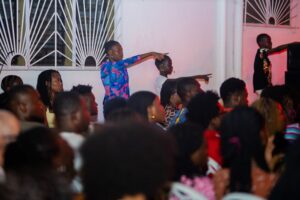
The production opens with a dialogue about a shocking event that has occurred in the community. Two characters discuss how someone had hurt girls in the community and how, when the girls tried to report, the adults around them warned them against raising false accusations. Then we see Reverend Armah himself, dressed in white, self-righteous and holy, praying fervently on the stage, asking God to deliver him. This scene is contrasted by a chorus dressed in black, who twist his words in song and call for his downfall. Here, the directors use foreshadowing and dramatic irony to put us slightly ahead of the story, thereby creating suspense.
Then a character breaks the fourth wall to share the town gossip with us. She tells us that Reverend Armah has disappeared. Before she can say more, she is shooed away by another character and admonished for being nosy. But at this point, the audience is already implicated. We are now part of what’s happening, even if we don’t yet know the full story.
This is the central tension the production sustains with remarkable skill: the thin line between fiction and truth. In theatre, there is the concept of the suspension of disbelief. It is the agreement the audience makes to temporarily set aside critical thinking and accept the play’s constructed world. The Disappearance of Reverend Armah calls us to do the opposite. It asks us to lean into belief. To sit with what is unfolding on stage and resist the comfort of reminding ourselves that it is not real. The fictional world the directors have created is not abstract. It is Kibera. It is Makoko. It is Alexandra. It is every working-class community in Africa where a man of God is above reproach, a teacher’s word outweighs a girl’s, and a mother will refuse to believe her child because she is not yet ready to confront the trauma of her own girlhood.
Theatre as Feminist Method
The production reflects art and theatre as feminist method in action. Feminism is a commitment to centering the lived experiences of women and girls, making the personal political, interrogating power rather than simply accepting it, and reconstructing systems that will liberate African women, girls, and gender-expansive people. Theatre, when doing its best work, does all of this. It does not tell us what we must think or know, but instead creates space for people to find their own way through questioning into understanding.
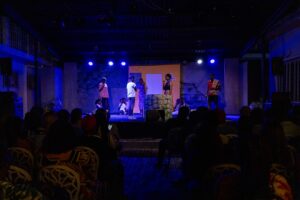
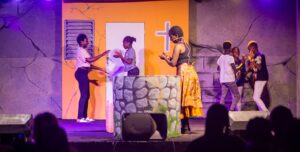
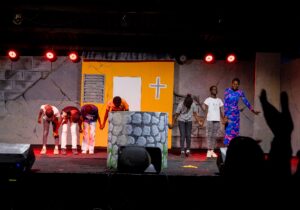
The Disappearance of Reverend Armah reminds us that art is political, doing so through multiple elements of craft. The set design was one of the many powerful elements of the production. The stage was composed of various mobile features, yet one structure remained constant throughout: a yellow house with a white door. It never moved. It was always there. Just watching.
As the story unfolds, we discover that the yellow house is Reverend Armah’s house, where he routinely sent girls, using discipline as a guise to perpetuate abuse. The immovable presence of this house on the stage forced us to sit with the knowledge that violence is all around us, and it happens to women, girls and gender-expansive people we know. The majority of sexual violence against African women and girls occurs in intimate spaces, in homes, schools, workplaces, churches, mosques, at the hands of people they know and trust. The set design refused to let the audience distance themselves from this fact. As long as patriarchy exists, the house will remain on the stage.
Lighting was used to convey the characters’ intimate inner experiences, which dialogue sometimes cannot. Fear. Shame. Isolation. Regret. Power. The sound design functioned as storytelling. It set the mood, evoked the familiarity of community, and provided moments of comic relief that reinforced the hard truths of our reality. The use of music to tell the story, particularly the Ga songs, was especially resonant. Language carries both meaning and power. Given Ghana’s colonial history and the imposition of English in the fabric of Ghanaian oral society, to sing about patriarchal oppression in the indigenous language of the community in which the story is set is to name the problem of colonisation directly.
This immersive form of staging, with actors engaging from within the audience, collapses the comfortable separation between observer and participant. We are not observers watching the town. We are townspeople. We were among those who heard the gossip, and some of us kept on walking.
Drama Queens and The Good Tree As Testimony
The Disappearance of Reverend Armah is not an abstract critique of patriarchy and colonisation. It is a real story belonging to a specific people at a specific time and place, and the collaboration with The Good Tree is central to the production’s political meaning. The Good Tree works to create safe spaces for girls in Teshie and to empower them to reach their full potential in a context where economic hardship renders them vulnerable. Teshie is a working-class community in Accra, and like many such communities, the pressures of poverty on girls create conditions that predators exploit. A man of faith and education holds tremendous power in such a context, handed to him by the people and protected by society. A society, which the production makes clear, includes us.
The production insists that the world depicted on the stage is neither theoretical nor fictional. It is real. Some of the actors are girls from the Good Tree community. By casting them as actors, the directors demand that we identify with these girls, and we are accountable to them. This directorial thinning of the line between reality and fiction is a political statement which speaks to the current context in Ghana. A context where perpetrators of sexual violence continue to move freely through institutions, where Professor Ransford Gyampo, a professor at the University of Ghana, was recorded on camera sexually harassing women he thought were students, but suffered no legal, social or economic consequences for his clear intent to abuse his power. Not only does he remain a lecturer at the same university, but he has also been appointed by the state to serve as the CEO of a government agency.
The Disappearance of Reverend Armah reveals that when art is in conversation with activism, each makes the other more powerful.
African Girls as Heroes of Their Own Story
One of the most significant feminist choices the production makes is to centre the girls not as passive victims, but as the heroes of their own story. When the schoolgirls reported Reverend Armah’s abuse to the elders around them and nothing was done, they refused to back down till their voices were heard. The production argues that children understand power and have the ability to challenge it when it is abusive. It asserts that when African girls are empowered and believed in, and given language to describe their experiences, and validated that their experiences are real, and affirmed that their pain is valid, and reminded that they are capable of autonomously engaging with society and negotiating the terms of their existence and participation in society, they have the power to save themselves and others.
Art is Political Because Living is Political
As a feminist and artist watching the production, I felt so affirmed to see a serious issue that is often dismissed by society depicted with full clarity through a skilled engagement with artistic craft, in a language and context familiar to me.
People are wired for story and for social connection, and when art brings those two together with skill and intention, it can reach us in ways that theory alone cannot. This is what feminist art does at its most powerful. It tells you that you were right to notice. That the thing you felt but couldn’t name was real. That your rage is proportionate and your grief is not excessive. Someone in the audience, after the final catharsis when Reverend Armah is finally caught, said something along the lines of, “He (the actor) did very well, but I hate him so much even though it’s not real.” I understood exactly what they meant. We had allowed ourselves to be fully immersed in the story and in the rage, the grief, and the relief of it all.
The Disappearance of Reverend Armah is a reminder that art is not separate from the world. It invites us to hold it and the world side by side to see more clearly, to feel all our feelings, to look critically at our society, to ask why and why not, to rage against the system, to be hopeful even when things seem hopeless, to rally behind one another and be ready to burn it all, and to remember that those girls on the stage saved themselves by insisting on seeing each other and refusing to back down from saying the truth. The production emphasises that telling the truth is an act of extraordinary courage, and we owe it to African girls everywhere to refuse to be complicit in systems that harm and silence them.
I left the theatre thinking about that house, still standing in the middle of the stage. Watching.
Fatima B. Derby (she/they) is an African feminist writer, dreamer and community organiser from Ghana working towards gender justice and queer liberation. Their work focuses on amplifying the voices of their community and exploring identity and power through artistic expression.