
On 12 November 2026, Veronica Lucy Gordon, one of South Sudan’s pioneering journalists and most steadfast women’s rights activists, was shot dead in Western Equatoria province. She was on her way with friends to Mundri Town, taking part in the political life of a country on the brink. She was returning from party primaries and congress activities in Lui Payam in Mundri East County with eight SPLM delegates when gunmen attacked their convoy at Miri Loko, killing Lucy and Justin Akim, a fellow party member and a delegate and leaving four delegates still missing.
For more than forty years, Lucy was a formidable force through every phase of South Sudan’s struggle for self-determination. She worked alongside women, supporting their political ambitions—and was killed as she entered political leadership herself.
We met Lucy back in 2010, before South Sudan was born in 2011 and before the hopes of independence were dampened by the militarism and civil crisis that have taken so many lives. For several years, while we worked with the Women’s International Peace Centre, Lucy was our guiding light, making the work possible in an environment so difficult for women, both politically and culturally. Together, we travelled to different states across South Sudan, documenting women’s realities and taking their voices and demands into national, African, and international policy and action. On long, uncertain paths, bumpy, barely existent roads and in crowded community meeting halls, she was a calm spirit, cooperative, never demanding, and carrying a quiet authority. She asked nothing for herself. To the women we worked with, interviewed and communed with, she gave her patience and her listening ear. It was the highest form of feminist leadership we can aspire to, the kind African women have long practised: leadership rooted in care, solidarity, and the everyday work of holding space for others.
That is what we have been denied, and what South Sudanese women are being denied. This is a grief we carry personally. The conflicts and political stakes in South Sudan have taken so many lives since 2013, and now Lucy, too, has been stolen from us.
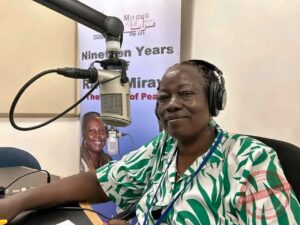
Veronica Lucy Gordon at Radio Miray. Photo by Radio Miraya
Her life and leadership
Her journey began at Lui Girls Secondary School, where she edited the wall bulletin, in the very area where she would lose her life. By 1983, she was writing about girls’ education in the Nile Mirror. Through the long years of war, she kept broadcasting, sheltering her children in trenches before going on air at Radio Juba. She rose to become Director of the English News Department at SSBC Radio, part of the national broadcaster, the South Sudan Broadcasting Corporation.
A stellar veteran journalist, she refused to succeed alone in a profession shaped by patriarchy. With the late Apollonia Mathia and others, she co-founded the Association of Media Women in South Sudan (AMWISS). She became the first woman on the board of the Association for Media Development in South Sudan (AMDISS), later its first woman Deputy Chairperson, and helped found the Union of Journalists of South Sudan (UJOSS). In 2024, she was named one of Africa’s 100 Most Influential Women. Many of the women who lead South Sudan’s media today stand on ground she cleared.
Her final step was into electoral politics through the SPLM, and shortly before her death she was reportedly nominated for a women’s seat in the National Legislative Assembly. She spent her life opening doors for women, and she was walking through one more when she was killed.
As we mark the 16 Days of Activism against Gender-Based Violence under the theme “Ensure justice, protect survivors, end impunity,” the violence has claimed another life. Lucy’s death reminds us that this violence is political. African feminists have long named what Lucy’s killing now lays bare: patriarchy guards the doors of power, and violence is one of its tools.
South Sudan heads to its first general elections since independence, on 11 February 2027, but in September the UN Commission on Human Rights in South Sudan warned that the conditions for peaceful, credible and inclusive elections are not in place. Women who travel to campaign face ambush on the road and unspeakable violence. The killing of Lucy and Justine adds to the rising civilian death toll along South Sudan highways. Women who stand for office face backlash, online abuse and doctored images. The 35% quota for women’s representation promised under the Revitalised Peace Agreement remains largely unmet. What South Sudanese women fought for in the independence struggle is still denied to them today, as the country remains locked in the politics of patriarchal power and militarism.
The bullet that took our friend’s life was not meant for her alone. It sends a message to every woman who is thinking of standing for office, campaigning or reporting: public life may cost you your life.
This is how women are pushed out of politics, not only by killing them, but by making participation so costly that families and parties keep them at home. Under the Maputo Protocol, African states committed to women’s equal participation in political life and to their right to live free from violence. Lucy’s death tests that promise. We are far from keeping it while the price of power is measured in bloodshed.
Because the violence is political, our response must be political too. In the spirit of this year’s call to ensure justice and end impunity, we call on the Government of South Sudan and the Western Equatoria State authorities to carry out an immediate, independent and transparent investigation into the Miri Loko attack, to bring those responsible to justice, and to keep searching until every missing delegate is found.
We call on the National Elections Commission, the Political Parties Council and the security services to treat violence against women in elections as a specific threat, and to protect women candidates, delegates, polling staff and journalists, especially when they travel. We call on political parties, including the SPLM, to honour the 35% commitment and take responsibility for the safety of the women they field.
We call on UNMISS, the African Union, IGAD and our international partners to monitor and publicly report violence against women in the electoral process, and to fund protection for women in politics and the media.
Too often, the situation in South Sudan falls off the radar of the media and of feminist action on the continent. With devastating conflicts raging in Sudan and Ethiopia, we have watched attention to political violence in South Sudan dwindle. We urge the African women’s movement and the media to keep their eyes on South Sudan too: keep Lucy’s name alive, support the women of South Sudan and those documenting every attack, and refuse to let fear decide who governs South Sudan.
Lucy, you reported under the raining bombs, you mentored through the hard years, and you travelled beside us with determination and grace. You opened doors long shut to women and held them open for the rest of us. You embodied the pan-African feminist struggle and expanded our dreams through true solidarity. You were taken while walking towards one more door, the door to Parliament. In the spirit of African sisterhood, we will finish that walk for you and keep calling for an end to impunity. A luta continua!
To Lucy’s children and family, to her colleagues at AMWISS, AMDISS, UJOSS and SSBC, and to the family of Justin Akim, we grieve with you.
Rest in power, Veronica Lucy Gordon!
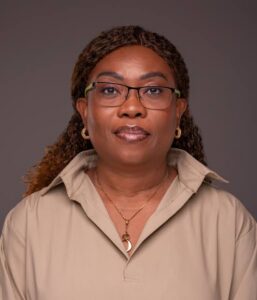
Dr. Helen Kezie-Nwoha is a feminist peacebuilder, researcher and policy advisor with experience in women, peace and security (WPS), gender and governance across Africa. She is the Founder and Executive Director of Researchers Without Borders. Helen chairs the Gender Is My Agenda Campaign at the African Union and is a member of the AU ECOSOCC Advisory Group on WPS and FEMWISE-Africa – the Network of African Women Mediators. She’s also the co-founder of the African Feminist Collective on Feminist Informed Policies(AfIP Collective)
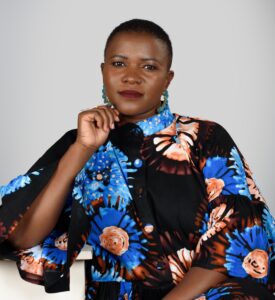
Rosebell Kagumire is a Pan-African feminist writer and analyst. She’s the Curator and Editor of African Feminism-AF and a columnist for New Internationalist magazine. She co-edited the book Challenging Patriarchy: The Role of Patriarchy in the Roll-Back of Democracy and is a contributing author to anthology Rising for Palestine: Africans in Solidarity for Decolonisation and Liberation. Kagumire is also a co-founder of the African Feminist Collective on Feminist Informed Policies(AfIP Collective).